If you are an exporter in Pakistan, one of the most important decisions you make after securing a U.S. customer is choosing the right way to move your cargo.
Should you use air freight from Pakistan to USA for faster delivery? Or should you choose sea freight from Pakistan to USA to keep transportation costs lower?
There is no single answer.
The right option depends on your cargo weight, dimensions, product value, delivery deadline, destination, and the cost of delays. For some exporters, air freight is worth paying more for. For others, sea freight can save thousands of dollars.
The U.S. remains Pakistan’s most important export market. Pakistan’s Economic Survey 2025-26 shows that the United States accounted for 19.9% of Pakistan’s exports during July–March FY2026, the largest share of any destination. More recently, Pakistan’s exports to the U.S. reached approximately $6.125 billion during FY2025-26.
That makes reliable Pakistan to USA shipping increasingly important for manufacturers, wholesalers, e-commerce businesses and exporters.
In this guide, we’ll compare air cargo and sea freight from Pakistan to USA, explain when each makes financial sense, discuss current 2026 shipping conditions, and show how exporters can reduce freight costs without sacrificing reliability.
Air Freight vs Sea Freight from Pakistan to USA: The Basic Difference
At its simplest:
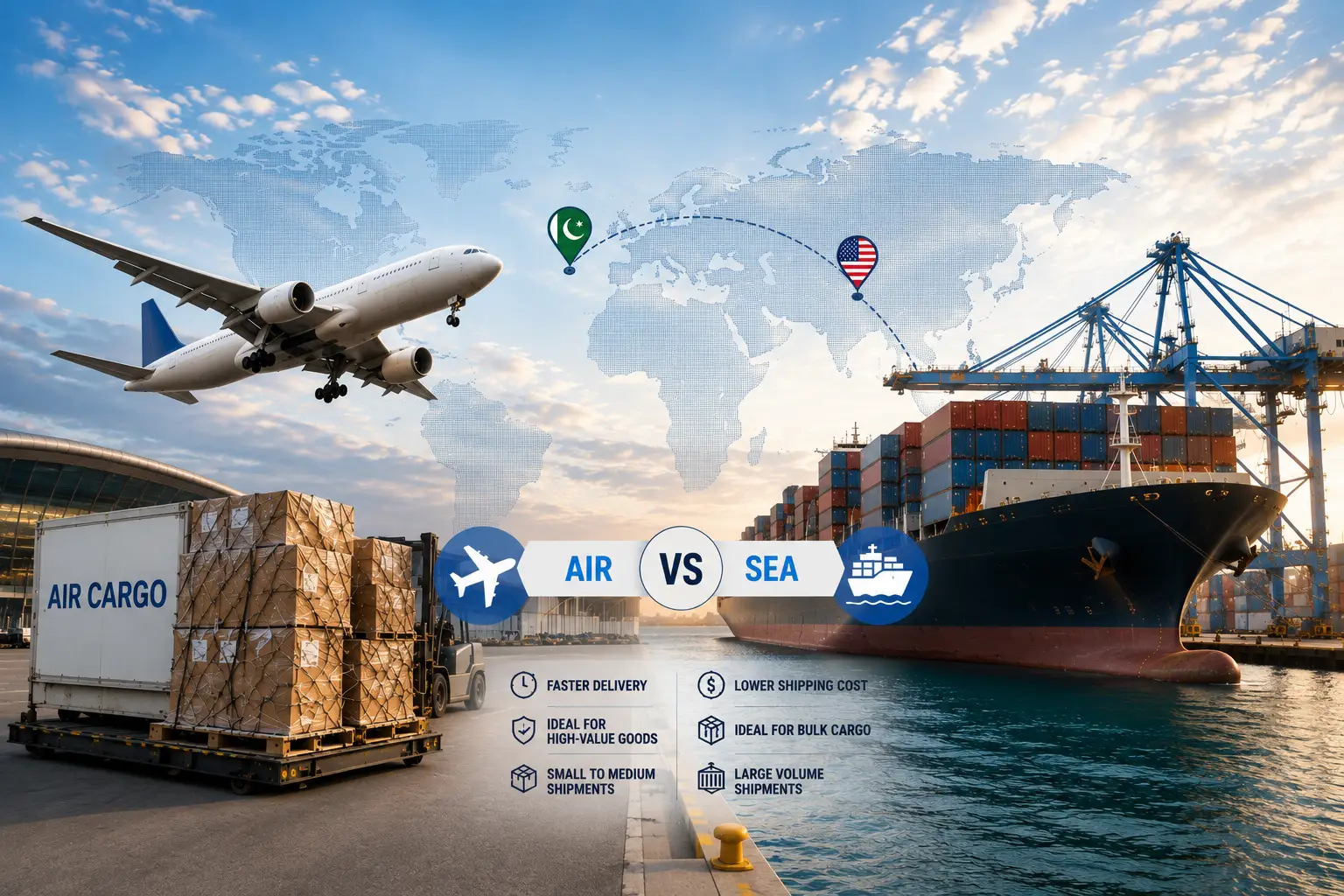
Air freight = faster delivery, higher freight cost
Sea freight = slower delivery, lower cost for larger shipments
But experienced exporters look beyond those two numbers.
A shipment that costs $2,000 by air and arrives quickly may be more profitable than a $1,000 sea shipment that arrives too late for a customer’s deadline.
Similarly, paying thousands more for air freight doesn’t make sense if your customer can comfortably wait several weeks.
The objective isn’t to find the cheapest cargo service from Pakistan to USA.
The objective is to find the most economical shipping solution for your particular shipment.
Air Freight from Pakistan to USA
Air freight is generally the better choice when speed is commercially important.
It can be particularly useful for high-value products, samples, urgent orders, replacement parts and relatively small shipments.
Air freight may be suitable when you are shipping:
- High-value goods
- Fashion products
- Sports samples
- Leather products
- Electronics and components
- Medical or industrial equipment
- Urgent spare parts
- E-commerce inventory
- Product samples
- Small commercial shipments
If your customer is waiting for an order, a faster Pakistan to USA cargo service can protect the relationship and potentially prevent lost sales.
The biggest advantage: time
Ocean shipments can involve multiple stages, including inland transportation, port handling, vessel schedules, transshipment and U.S. customs clearance.
Air freight removes much of the long ocean transit period.
That doesn’t mean every air shipment arrives immediately. Customs, handling, documentation and final-mile delivery still take time.
But when your priority is getting cargo into the United States quickly, air cargo from Pakistan to USA can be a powerful option.
Sea Freight from Pakistan to USA
For large or heavy shipments, sea freight is usually the more economical choice.
This is especially true when your products have a relatively low value compared with their weight or volume.
Sea freight may be appropriate for:
- Large commercial orders
- Full container loads
- Heavy machinery
- Textiles
- Home furnishings
- Leather goods
- Sports goods
- Bulk manufactured products
- Non-urgent inventory
If your customer is ordering a large quantity of products and has enough lead time, sea freight from Pakistan to USA can substantially reduce the transportation cost per unit.
The trade-off is time.
For example, current freight-rate data for a Karachi-to-New York lane shows ocean options with estimated transit times ranging from roughly 27 days to more than 40 days, depending on the service and routing.
Transit time can vary considerably by destination, routing, carrier and operating conditions, so exporters should always request a current quote rather than relying on a generic online estimate.
Which Is Cheaper: Air Freight or Sea Freight?
For most large shipments, sea freight is cheaper on a per-unit basis.
But “cheaper” needs context.
Consider an exporter shipping 500 kg of products.
If air freight costs significantly more but delivers the products weeks earlier, the exporter needs to ask:
What is the financial value of those extra weeks?
If the products are urgently needed to fulfill customer orders, the higher air freight cost may be justified.
On the other hand, if the goods are being shipped months before they are needed, there may be little reason to pay the air premium.
This is why the best freight forwarder in Pakistan should ask questions about your business rather than simply quoting one transportation method.
Pakistan to USA Shipping Cost: What Determines Your Rate?
There is no universal Pakistan to USA shipping rate.
Your actual freight quotation can depend on:
- Cargo weight
- Cargo dimensions
- Chargeable weight
- Product type
- Packaging
- Pickup city
- Departure airport or seaport
- U.S. destination
- Air or ocean service
- FCL or LCL
- Door-to-door or port-to-port service
- Fuel surcharges
- Peak-season surcharges
- Customs and handling
- Carrier availability
- Delivery urgency
This is particularly important when comparing cargo shipping rates from Pakistan to USA.
A quotation that looks cheaper at first may not include every cost involved in getting the shipment from your warehouse to the customer’s location.
Always ask what the quoted price includes.
1. When Should You Choose Air Cargo to USA?
Air freight is usually worth considering when time has a direct financial value.
Choose air freight when your shipment is urgent
If a customer needs goods within days rather than weeks, air freight may be the practical choice.
Choose air freight for high-value products
When your cargo is expensive relative to its weight, faster transportation may make more sense financially.
Choose air freight for smaller shipments
For relatively small commercial consignments, air freight can provide a practical alternative to waiting for an ocean shipment.
Choose air freight for samples
If you’re sending product samples to a potential buyer in New York, Los Angeles, Chicago, Houston or another U.S. market, speed can help shorten the sales cycle.
Choose air freight for urgent replenishment
If your U.S. distributor is almost out of inventory, waiting several additional weeks could cost more than the additional freight expense.
2. When Should You Choose Sea Freight?
Sea freight becomes more attractive when volume and cost efficiency matter more than speed.
Choose sea freight for large shipments
Full-container shipments can achieve much better economics than moving the same volume by air.
Choose sea freight for non-urgent cargo
If your customer has provided a comfortable delivery window, there’s often little reason to pay an air freight premium.
Choose sea freight for heavy products
Heavy machinery, large quantities of textiles, furniture and other bulky products can become prohibitively expensive by air.
Choose sea freight for regular export programs
Businesses with predictable monthly shipments can plan production and booking schedules around ocean transit times.
Air Freight vs Sea Freight: Quick Comparison
| Factor | Air Freight | Sea Freight |
|---|---|---|
| Speed | Fast | Much slower |
| Cost per kg/unit | Higher | Lower for larger volumes |
| Best for | Urgent and high-value goods | Bulk and heavy cargo |
| Small shipments | Often suitable | LCL may be suitable |
| Large shipments | Expensive | Usually economical |
| Inventory replenishment | Excellent | Requires planning |
| Samples | Excellent | Usually unnecessary |
| Urgent orders | Excellent | Not ideal |
| Long-term planning | Useful | Very important |
The key takeaway is simple:
Air freight sells time. Sea freight sells volume efficiency.
How Pakistani Exporters Can Reduce Freight Costs
Even if you’re using air freight, there are several ways to reduce freight costs.
Optimize Your Packaging
Packaging affects shipping costs more than many exporters realize.
Airlines may calculate charges using volumetric weight, while ocean freight can also be affected by container utilization.
If you’re shipping products in oversized cartons, you could be paying to transport empty space.
Review:
- Carton dimensions
- Packaging material
- Number of cartons
- Product arrangement
- Pallet configuration
A small packaging improvement across hundreds of shipments can create meaningful savings.
Consolidate Shipments When Practical
If you have several small orders going to the United States, consolidation may reduce your overall transportation expense.
For example, instead of sending several separate shipments every few days, you might consolidate compatible cargo into one larger shipment.
However, don’t consolidate simply because it sounds cheaper.
If waiting for another shipment means missing your customer’s deadline, the saving may not be worth it.
Compare FCL and LCL
For ocean freight, exporters should understand the difference between:
FCL — Full Container Load
and
LCL — Less than Container Load
FCL may make sense when you have enough cargo to efficiently use a container.
LCL can be useful when your shipment doesn’t justify a full container.
A good freight forwarding company in Pakistan can compare both options based on your cargo volume and destination.
How to Avoid Shipping Delays from Pakistan to USA
A cheap shipment isn’t cheap if it arrives too late.
This is particularly important in 2026, when global transportation markets remain sensitive to fuel costs, route disruptions and capacity changes.
In August 2026, major carriers announced peak-season surcharges affecting shipments from Pakistan and other Indian Subcontinent origins to U.S. destinations. Maersk, for example, announced a peak-season surcharge for shipments from Pakistan and other regional origins to the U.S. West Coast effective August 4, 2026.
CMA CGM has also published peak-season surcharge updates covering cargo from Pakistan to U.S. East and Gulf Coast destinations.
For exporters, this means freight planning shouldn’t be based on an old quotation sitting in your inbox.
To avoid shipping delays:
Book early.
Don’t wait until cargo is sitting in your warehouse.
Prepare documentation correctly.
Errors in invoices, packing lists, HS classifications or other documents can create clearance problems.
Give accurate dimensions and weights.
Incorrect information can lead to re-rating and unexpected charges.
Discuss deadlines with your freight forwarder.
Your logistics provider needs to know when the customer actually needs the goods.
Have a backup option.
If a shipment is extremely time-sensitive, understand what alternative routing or transportation options are available.
U.S. Destinations Matter Too
“Shipping to the USA” isn’t one single route.
Shipping from Pakistan to New York is different from shipping to Los Angeles, Houston, Chicago, Dallas or another U.S. destination.
Your final destination can influence:
- Port selection
- Airport selection
- Inland transportation
- Transit time
- Customs handling
- Delivery cost
- Available carriers
For example, Karachi-to-New York ocean freight may involve a different routing and transit profile than cargo moving toward the U.S. West Coast.
That is why a professional Pakistan to USA freight forwarder should quote based on the actual delivery location rather than simply providing a generic “USA rate.”
Pakistan’s Major Export Products to the USA
The U.S. market is particularly important for Pakistani exporters of manufactured products.
Common export categories include:
- Textiles
- Home textiles
- Bed linen
- Towels
- Apparel
- Leather products
- Sports goods
- Surgical instruments
- Rice
- Other manufactured and agricultural products
For example, textile exporters may find sea freight more economical for large commercial orders, while samples or urgent replenishment may be better suited to air freight.
The right method depends on the shipment rather than simply the product category.
2026 Shipping Trends Pakistani Exporters Should Watch
The international freight market is not standing still.
Fuel prices, geopolitical developments, peak-season demand, carrier capacity and trade policy can all influence international shipping rates in 2026.
Current U.S.-Pakistan trade remains significant. U.S. goods imports from Pakistan totaled $5.4 billion in 2025, while total U.S. goods trade with Pakistan reached approximately $8.7 billion.
Meanwhile, U.S. trade conditions and transportation surcharges continue to evolve.
For Pakistani exporters, the lesson is not to panic every time freight rates change.
Instead:
Monitor the market.
Plan ahead.
Compare transportation options.
Don’t assume last month’s rate is today’s rate.
And most importantly, build shipping decisions around your actual business requirements.
How a Freight Forwarder in Pakistan Can Help
A reliable freight forwarder Pakistan exporters can trust should do more than arrange transportation.
The right logistics partner can help you compare:
- Air freight
- Sea freight
- FCL
- LCL
- Airport-to-airport services
- Port-to-port services
- Door-to-door cargo
- Different carriers and routes
They can also help with:
- Cargo pickup
- Documentation
- Shipment tracking
- Customs coordination
- Route planning
- Delivery scheduling
- Freight cost comparison
For exporters who ship regularly to the United States, this can make logistics much easier to manage.
A Simple Decision Formula for Exporters
Before choosing between air and sea freight, ask yourself five questions:
1. How urgent is the shipment?
If the answer is “very urgent,” start with air freight.
2. How much does the cargo weigh?
Heavy shipments often favor ocean freight.
3. What is the cargo worth?
High-value, lightweight goods can justify air freight.
4. What happens if the shipment arrives two or three weeks late?
If the answer is “we lose a customer or significant sales,” speed becomes more valuable.
5. What is the customer’s delivery deadline?
This should influence your shipping method from the beginning—not after production is finished.
Final Thoughts: The Cheapest Shipping Option Isn’t Always the Best
When choosing Pakistan to USA shipping, don’t make the decision based solely on the lowest freight quotation.
Air freight costs more, but it can protect urgent orders, reduce replenishment time and help high-value products reach the U.S. market quickly.
Sea freight takes longer, but it can provide significantly better economics for large, heavy or non-urgent shipments.
The smartest exporters don’t ask:
“Which is cheaper?”
They ask:
“Which option gives me the best balance of cost, speed and reliability for this shipment?”
That mindset can help you reduce freight costs, avoid unnecessary delays and protect your profit margins.
If you’re regularly exporting from Pakistan to the United States, working with an experienced freight forwarder in Pakistan can make this decision much easier. A good logistics partner can compare routes, service levels and current freight rates based on your actual cargo rather than giving you a generic price.
For businesses shipping high-value or time-sensitive goods, you may also find our guide on air cargo useful: Swift Delivery: Why Air Cargo to Pakistan Is the Best Choice for High-Value Goods from China.
Need a Pakistan to USA shipping quote? Share your cargo type, weight, dimensions, pickup location and U.S. destination with Pacewell Cargo to explore the most suitable air or sea freight option for your shipment.