For businesses importing high-value products from China, waiting several weeks for a shipment to arrive can be more expensive than paying a little extra for faster transportation. A delayed shipment can mean empty shelves, missed sales, production downtime, unhappy customers, or a product launch that arrives too late. That is where air cargo to Pakistan becomes particularly valuable.
China is already Pakistan’s largest import source. Pakistan’s Economic Survey 2025-26 reports that imports from China reached a projected $14.04 billion in FY2026, representing around 30% of Pakistan’s total imports. Meanwhile, Pakistan-China trade activity continues to expand, making reliable logistics between the two countries increasingly important for importers.
For high-value electronics, machinery components, medical equipment, samples, fashion products, spare parts and other time-sensitive goods, air freight can offer something sea freight simply cannot match: speed.
But does that mean air freight is always the best choice?
Not necessarily.
The smart decision depends on your product value, shipment weight, urgency, destination, packaging and total logistics cost. In this guide, we’ll look at why air cargo from China to Pakistan can be the right solution for valuable goods, how pricing works, when it makes financial sense, and how importers can reduce freight costs and avoid shipping delays.
Why Air Cargo to Pakistan Makes Sense for High-Value Goods
The biggest advantage of air freight is straightforward: time.
Ocean freight can be economical for large shipments, but it usually requires significantly more transit time and involves additional stages in the supply chain.
Air cargo moves goods much faster.
That difference matters when the cargo itself is valuable.
Imagine you are importing:
- Premium electronics
- Computer components
- Mobile accessories
- Industrial machinery parts
- Medical equipment
- Luxury fashion items
- Product samples
- High-value automotive parts
- Specialized tools
- Urgent replacement components
If a shipment worth hundreds or thousands of dollars sits in transit for weeks, the cost of waiting can quickly become greater than the freight savings.
For a business, the question shouldn’t simply be:
“What is the cheapest shipping method?”
A better question is:
“What shipping method gives me the best total business value?”
Sometimes, the answer is air cargo to Pakistan.
1. Speed Can Protect Your Cash Flow
Time is money in importing.
Suppose you run an e-commerce business and your best-selling product is almost out of stock.
You have two choices:
Option A: Use cheaper sea freight and wait weeks for replenishment.
Option B: Pay more for air freight and receive the inventory much sooner.
Option B has a higher transportation cost, but it may allow you to continue selling without a long stockout.
For high-margin products, the additional air freight cost can sometimes be justified by protecting sales.
This is one of the main reasons experienced importers don’t automatically choose the lowest freight quotation.
2. Air Freight Can Reduce Inventory Risk
Long transit times require better inventory planning.
When your products take weeks to arrive, you need to maintain more safety stock to protect against unexpected demand or shipping delays.
Air cargo allows businesses to replenish inventory faster.
That can be particularly useful for:
- Online sellers
- Electronics distributors
- Spare-parts suppliers
- Fashion businesses
- Technology companies
- Manufacturers
- Importers dealing with seasonal products
You may pay more per kilogram for air freight, but faster replenishment can reduce the amount of inventory you need sitting in storage.
That’s an important part of calculating the real cost of shipping from China to Pakistan.
3. Air Cargo Is Particularly Useful for Smaller Shipments
Sea freight becomes more attractive as shipment volume increases.
But what if you only need 50 kg, 100 kg, or a few cartons?
For relatively small shipments, air freight can be much more practical.
Instead of waiting to build a large ocean shipment, you can move the required goods quickly.
This is especially useful for businesses importing from major Chinese commercial hubs such as:
- Guangzhou
- Shenzhen
- Shanghai
- Yiwu
- Beijing
- Ningbo
Depending on the supplier’s location and available airline connections, a China to Pakistan air cargo service can provide a practical solution for urgent or relatively small commercial shipments.
4. What About the Cheapest Air Cargo from China to Pakistan Per KG?
This is one of the most common questions importers ask:
“What is the cheapest air cargo from China to Pakistan per kg?”
The honest answer is that there isn’t one fixed price that applies to every shipment.
Air cargo rates can change based on:
- Chargeable weight
- Actual weight
- Volumetric weight
- Origin airport
- Destination airport
- Commodity
- Airline capacity
- Fuel surcharges
- Season
- Shipment dimensions
- Customs requirements
- Door-to-door vs airport-to-airport service
- Delivery urgency
Recent 2026 market guides have published indicative China-to-Pakistan air-freight benchmarks ranging from roughly $3–$8 per kg, depending heavily on shipment weight. These figures should be treated as market indications rather than guaranteed quotes.
For example, a shipment weighing 500 kg may receive a completely different rate from a 30 kg shipment.
So when comparing the cheapest air cargo from China to Pakistan per kg, don’t look at the number alone.
Ask what is actually included.
A cheaper headline rate may exclude handling, customs clearance, local delivery or other charges.
5. Understand Chargeable Weight Before Booking
One of the easiest ways for new importers to underestimate air freight costs is by looking only at the actual weight.
Airlines commonly consider chargeable weight, which can be based on whichever is greater between actual and volumetric weight.
For example, a lightweight but bulky shipment may occupy significant aircraft space.
That means:
Light doesn’t always mean cheap.
Before requesting an air cargo quotation, provide your freight forwarder with:
- Number of cartons
- Length
- Width
- Height
- Gross weight
- Product description
- Pickup location
- Destination
Accurate dimensions can help you get a much more realistic quote.
6. Air Cargo Can Help You Avoid Shipping Delays
No importer wants to hear:
“Your shipment is delayed.”
But international logistics doesn’t always go according to plan.
Cargo can be affected by:
- Port congestion
- Vessel schedule changes
- Route disruptions
- Customs issues
- Documentation errors
- Weather
- Capacity shortages
- Operational problems
Recent global shipping conditions demonstrate why transportation schedules can remain unpredictable. In August 2026, Maersk raised its earnings outlook while citing higher freight rates associated with strong demand, global trade disruptions and port congestion.
Air freight doesn’t eliminate every logistics risk, but it can reduce dependence on longer ocean transit schedules.
For urgent goods, that can make a major difference.
China to Pakistan Air Cargo: Which Route Is Best?
The best route depends on where your supplier is located and where the goods need to be delivered in Pakistan.
Common Chinese sourcing locations include:
Guangzhou to Pakistan
Guangzhou is a major commercial and manufacturing center, particularly for consumer products, apparel, electronics and wholesale goods.
Shenzhen to Pakistan
Shenzhen is particularly important for electronics, technology products and components.
Yiwu to Pakistan
Yiwu is widely used by importers sourcing consumer goods, accessories, household products and small merchandise.
Shanghai to Pakistan
Shanghai serves a broad range of industrial and commercial cargo and is an important international logistics hub.
On the Pakistan side, shipments may be routed through airports serving major commercial centers such as Karachi, Lahore and Islamabad, depending on the airline, service and final destination.
This is why there is no single “best China to Pakistan shipping route” for every importer.
Your supplier’s location, cargo characteristics and final delivery address all matter.
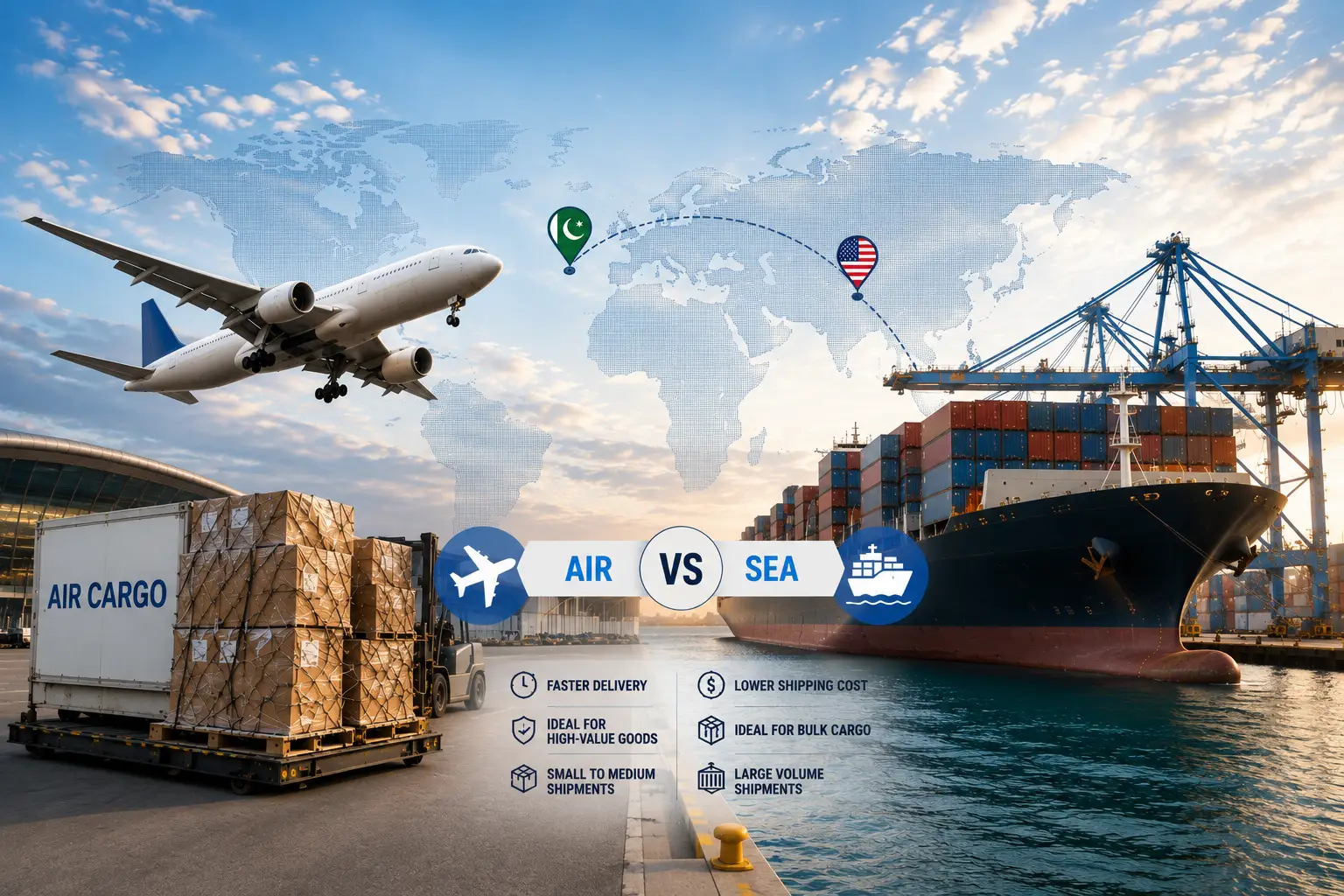
Air Freight vs Sea Freight from China to Pakistan
So, should you use air or sea?
Here’s a practical comparison.
| Factor | Air Freight | Sea Freight |
|---|---|---|
| Speed | Very fast | Slower |
| Cost per kg | Higher | Usually lower for large volumes |
| Best for | High-value & urgent cargo | Bulk & heavy shipments |
| Shipment size | Small to medium | Medium to very large |
| Inventory replenishment | Excellent | Requires more planning |
| Urgent spare parts | Excellent | Usually unsuitable |
| Large low-value cargo | Less economical | Usually better |
The important point is that air freight isn’t competing with sea freight on price.
It is competing on time, reliability and business value.
If your product is expensive, time-sensitive or relatively small, air freight can make much more sense.
How to Reduce Freight Costs When Using Air Cargo
Air freight is faster, but that doesn’t mean you should accept an unnecessarily expensive quotation.
There are several ways importers can reduce freight costs.
Optimize Your Packaging
Large boxes containing small products can create unnecessary volumetric weight.
Ask your supplier whether packaging can be redesigned without compromising product protection.
Even a small reduction in carton dimensions can matter when multiplied across several cartons.
Consolidate Shipments
If you have multiple suppliers in China, consolidation may allow you to combine goods before shipping.
Instead of paying for several small shipments, a consolidated shipment may qualify for a better rate.
However, consolidation only makes sense when the additional handling time doesn’t defeat the purpose of using air freight.
Compare Multiple Service Levels
Don’t assume the fastest available service is always necessary.
If your customer needs delivery in seven days, paying a premium for a service designed for much faster delivery may not be necessary.
Tell your freight forwarder in Pakistan your actual deadline rather than simply asking for the fastest option.
Provide Accurate Cargo Information
Incorrect dimensions or product descriptions can create quotation problems and delays.
Give your logistics provider complete shipment details from the beginning.
This makes it easier to identify the right service and provide a realistic estimate.
How to Avoid Customs and Documentation Delays
Fast transportation doesn’t help much if your cargo gets stuck during clearance.
Before shipping from China to Pakistan, make sure your commercial documentation is accurate and consistent.
Depending on the shipment, documentation may include:
- Commercial invoice
- Packing list
- Air waybill
- Product description
- HS code
- Import-related documents
- Certificates or permits where applicable
Your exact requirements can vary depending on the commodity and applicable Pakistani import regulations.
A professional logistics provider can help identify documentation requirements before the shipment moves.
That is much better than discovering a problem after the cargo has already arrived.
Why a Freight Forwarder Matters
A good freight forwarder in Pakistan should do more than simply move a box.
The right logistics partner can help you:
- Compare air freight options
- Calculate chargeable weight
- Coordinate supplier pickup
- Arrange consolidation
- Prepare shipping documentation
- Track cargo
- Coordinate customs clearance
- Arrange final delivery
- Identify potential delays
For importers bringing high-value products from China, this support can be extremely valuable.
A few dollars saved on freight isn’t necessarily a saving if the shipment arrives late, gets held because of incorrect paperwork, or generates unexpected charges.
China-Pakistan Trade Is Creating More Logistics Demand
The China-Pakistan trade relationship continues to be a major part of Pakistan’s import and industrial landscape.
Pakistan’s FY2026 Economic Survey projects China to account for about 30% of Pakistan’s total imports, highlighting just how important China is to the country’s supply chain.
At the same time, bilateral commercial activity continues to develop. Pakistan and Chinese companies signed agreements worth approximately $1.22 billion at a business conference in Hangzhou in May 2026, another indication of continued commercial engagement between the two countries.
For importers, the implication is simple:
Reliable China-Pakistan logistics will continue to matter.
As sourcing from China grows, businesses will need transportation options that balance speed, cost and reliability.
When Should You Choose Air Cargo to Pakistan?
Air freight is usually worth considering when:
Your goods are high-value
If the value of your cargo is high relative to its weight, faster transportation can be easier to justify.
Your shipment is urgent
Production lines and customer orders don’t always wait for economical shipping schedules.
Your shipment is relatively small
For smaller commercial consignments, air freight can be practical.
You need fast inventory replenishment
If running out of stock means losing sales, speed has a financial value.
You are shipping samples
Businesses testing products or sending samples to customers may prefer speed over low transportation cost.
You need urgent spare parts
A missing component can sometimes stop an entire production process. In such cases, saving on freight may be far less important than getting the part delivered quickly.
Final Thoughts: Pay for Speed When Speed Has Business Value
There is no universal answer to whether air freight is better than sea freight.
For a large shipment of low-value goods, ocean freight may be the obvious choice.
But for high-value, lightweight, urgent or time-sensitive products, air cargo to Pakistan can be the smarter business decision.
The key is to look beyond the freight rate.
Consider the value of your inventory, the cost of being out of stock, the risk of delays, your customer’s expectations and the total landed cost.
And if you’re comparing the cheapest air cargo from China to Pakistan per kg, remember that the lowest quoted number isn’t necessarily the lowest overall cost. Always compare what the quotation includes, how chargeable weight is calculated, the expected transit time and whether customs or final delivery are covered.
For a broader look at how international freight costs are changing and what exporters can do to control them, read our guide: Why International Shipping Rates Are Rising — And How Exporters Can Save in 2026
If you’re importing high-value goods from China and need a practical China to Pakistan air cargo solution, work with a freight partner that can compare the available options rather than simply giving you one rate.
Need a China-to-Pakistan shipping quote? Contact Pacewell Cargo with your product type, weight, dimensions, pickup city and destination for a tailored freight solution.